HUNT, GEORGE 
Private 3950
The Queen's (Royal West Surrey Regiment)
Died 19-February-1916 aged 32
George Hunt was born in India.
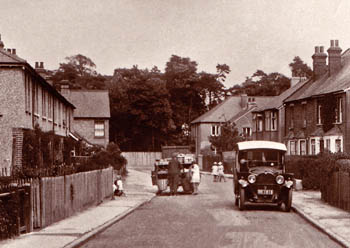
Later in life, he married Martha and they lived in Ferndale Road Banstead. The photo below shows the terraced houses on the left hand side of Ferndale Rd, where three generations of the Hunts, including George Hunt lived.
 George and Martha
had four children, George and Martha
had four children,
Edith, William, Albert and Alfred.
George was attached to the 1st Battalion The Queen's (Royal West Surrey Regiment) and their war movements are listed below:
August 1914 : in Bordon Camp. Part of 3rd Brigade, 1st Division.
Landed at Le Havre 13 August 1914.
8 November 1914 : transferred to I Corps.
21 July 1915 : transferred to 5th Brigade, 2nd Division.
15 December 1915 : transferred to 100th Brigade, 33rd Division.
The 100th Brigade included
16th (Service) Battalion (Public Schools), The Middlesex Regiment (until February 1916)
16th (Service) Battalion (Church Lads Brigade), King's Royal Rifle Corps
1st Battalion, The Queen's (Royal West Surrey Regiment)
2nd Battalion, The Worcestershire Regiment
The Regimental war diary shows the regiment was in the
area of Bethune in January 1916 then Annequin la Fosse and Beuvry.
The diary records a relatively quiet period with "ordinary routine" shown
against quite a few days. Other entries record patrolling the trenches and
occasional shelling. The enemy line was reported to be very thick
and unpassable even by a single man.
In the first 18 days of February a total of 6 men were killed and 5 wounded. On the day that Private George Hunt was killed, the diary records the following;-
 "
Shelling caused at about 10.30 am 600x behind our trenches (front line).
Sergt ARCHER A. H. recommended for bravery and helping mechanic under
heavy shell and M.G. (machine gun) fire.... "
Shelling caused at about 10.30 am 600x behind our trenches (front line).
Sergt ARCHER A. H. recommended for bravery and helping mechanic under
heavy shell and M.G. (machine gun) fire....
2 killed 10 wounded.
"
 It was normal
practice not to name the lower ranks killed and but it is likely that
George Hunt was one of the two men killed on that day. It was normal
practice not to name the lower ranks killed and but it is likely that
George Hunt was one of the two men killed on that day.
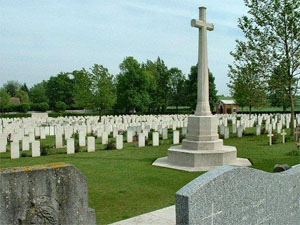
Katherine Barnard, nee Hunt, George's granddaughter researched her family history and made a point of visiting her grandfather's grave in France.
Grave Reference: F. 7.
CAMBRIN MILITARY CEMETERY
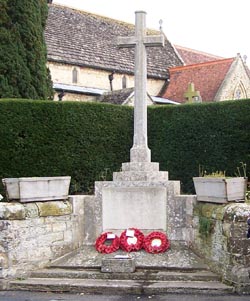
 On the 100th anniversary of George's death, Kathy attended a commemoration service at All Saints church in Banstead,where the bells were tolled one hundred times in honour of George Hunt. On the 100th anniversary of George's death, Kathy attended a commemoration service at All Saints church in Banstead,where the bells were tolled one hundred times in honour of George Hunt.
Kathy was able to wear the very medals awarded to George after a collector found his story on this website and got in touch.
Source : Commonwealth War Graves
Commission.
Regimental war
Regimental diary entries from The Queens Royal regiment Archive
Enquiry re uniform sent to
allthequeensmen.co.uk 4 May 2009
G Hunt picture
supplied by granddaughter Katherine Barnard in May 2009
Photo on left by James Crouch.
All Saints WWl Memorial Banstead Surrey.
Wood panel All Saints Church
Banstead.
............................................................... back to Top Panel 3
Last updated: 10 Sept 2016 | 

 Harry is remembered along with his brother Fred Harding of The Royal Hussars, on the Fletching War Memorial.

 HILLMAN, John (Jack)

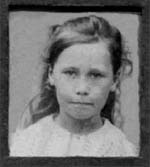
 Jack
was a lively and likeable character and according to his sister, popular
with the girls.
Jack
was a lively and likeable character and according to his sister, popular
with the girls.  The white feather was bestowed on 'slackers' by chauvinist women in the First World War. The notion of a white feather representing cowardice goes back to the 18th century, arising from the belief that a white feather in the tail of a game bird denoted poor quality. To 'show the white feather' was therefore to be 'unmanly'.


 The
more elaborate dugouts, as these tunnels were
known, were often forty feet deep with a main shaft descending through
the layer of blue clay well below the surface. The blue clay was impermeable
to water and was the cause of so much mud on the battlefield as the heavy rain
had nowhere to go. The Royal Engineers
built the tunnels below the blue clay and sufficiently deep to avoid damage
from the shells of the German heavy guns. Each tunnel had basic sleeping
bunks where weary soldiers, probably officers, could get some respite from
the dangerous, noisy and wet conditions up above.
The
more elaborate dugouts, as these tunnels were
known, were often forty feet deep with a main shaft descending through
the layer of blue clay well below the surface. The blue clay was impermeable
to water and was the cause of so much mud on the battlefield as the heavy rain
had nowhere to go. The Royal Engineers
built the tunnels below the blue clay and sufficiently deep to avoid damage
from the shells of the German heavy guns. Each tunnel had basic sleeping
bunks where weary soldiers, probably officers, could get some respite from
the dangerous, noisy and wet conditions up above.
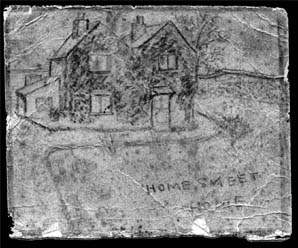
 His parents never saw his grave but amongst the items
returned to them was a small pencil
sketch of Park Farm, Jack's home in Banstead. It is something he carried with him
to remind him of 'HOME SWEET HOME' and was almost certainly
retrieved from his pocket after he was killed.
His parents never saw his grave but amongst the items
returned to them was a small pencil
sketch of Park Farm, Jack's home in Banstead. It is something he carried with him
to remind him of 'HOME SWEET HOME' and was almost certainly
retrieved from his pocket after he was killed.
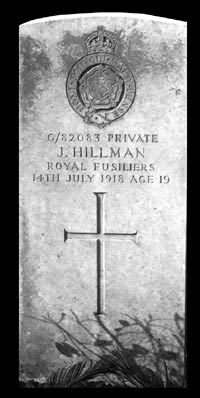
 Jack's
brother William survived the war but not without serious injury.
Jack's
brother William survived the war but not without serious injury.