Banstead History Logo

Miscellaneous items

Last updated: 9 Dec 2022

This page lists and describes a number of miscellaneous items which do not fall under the other Fastpath categories. An appropriate photograph or picture is included where Banstead History has one.

Book on the heritage of the  longbow by Pip Bickerstaff.Archery
In Henry VIII's time in 1544, Banstead Village had to have a trained quota of archers, ready for home defence. They were paid 6d (that's less than 3p) a day. This high rate reflected the great effort being made at the time to maintain the use of the English long bow.

The field for Archery practice called Butts which is the name for the targets used in archery today, was on the edge of Banstead Downs, now the last houses on the right going down Sutton lane. In 1580 various Banstead people were taken to court for not having bows and arrows. Archery continues locally as a sport to this day.

'Book on the heritage of the longbow by Pip bickerstaff.'


Banstead Athletic Football Club
One of the few clubs to be founded during the 2nd World War, Banstead began football activities in season 1944/45 under the name Banstead Juniors. During the close season of 1946/47 they changed the name of the club to Banstead Athletic F.C. In their first year in the league, Athletic won the Surrey Intermediate Cup and the following two seasons captured the League title. After five successful years at junior/intermediate level, Banstead achieved senior status and joined the Surrey Senior League for season 1949/50.
BAFC Badge
www.bansteadathletic.co.uk
The promotion to senior football marked the start of Banstead's Glory Days as the next decade brought them an abundance of honours.

Before the commencement of season 1950/51 Banstead moved from the Recreational ground to their present headquarters at Merland Rise. The first season at the new ground saw Athletic win the League title. They proceeded to win the title for the next three seasons, making it a record four continuous championships.

They joined the Spartan League for season 1965/66.

Banstead joined the Athenian League in 1979/80 and won the League Cup in 1980/81. 1984/85 saw the demise of the Athenian League and Banstead joined the Isthmian League Division Two (South).

Towards the end of season 1989/90 the club faced closure over a dispute with the local council on ground leasing. Fortunately the then Reserve team manager Terry Molloy, rescued the club and became the new owner and Chairman of Banstead Athletic. He then improved facilities at Merland Rise with the installation of new floodlights and the upgrading of clubhouse amenities.

During 1993/94 season, considerable ground improvements were carried out with the help of Epsom & Ewell, to acquire a Grade C rating and later, during 1994/95 further ground improvements secured a B grading.

Banstead Downs Golf Club
Banstead Downs golf club - clubhouse. Postcard from Lewis Wood collection.The Wallington and Carshalton Herald of 18th October 1890 tells us that 'A golf club has been got up upon Banstead Downs'.
In March 1896, the committee decided that the club uniform should be a red coat with green collar,and initials SGC (Sutton Golf Club). Unusually, the club had been founded as the Sutton Ladies Golf Club and the men were only let in afterwards.

The current name - Banstead Downs Golf Club has been in use since 1904.

The club have no web site but the history of the club is recorded in a book called BDGC, The first hundred years 1890-1990' available at Banstead library.


This picture of the clubhouse dates to around 1910.

Banwood Folk Dance Club

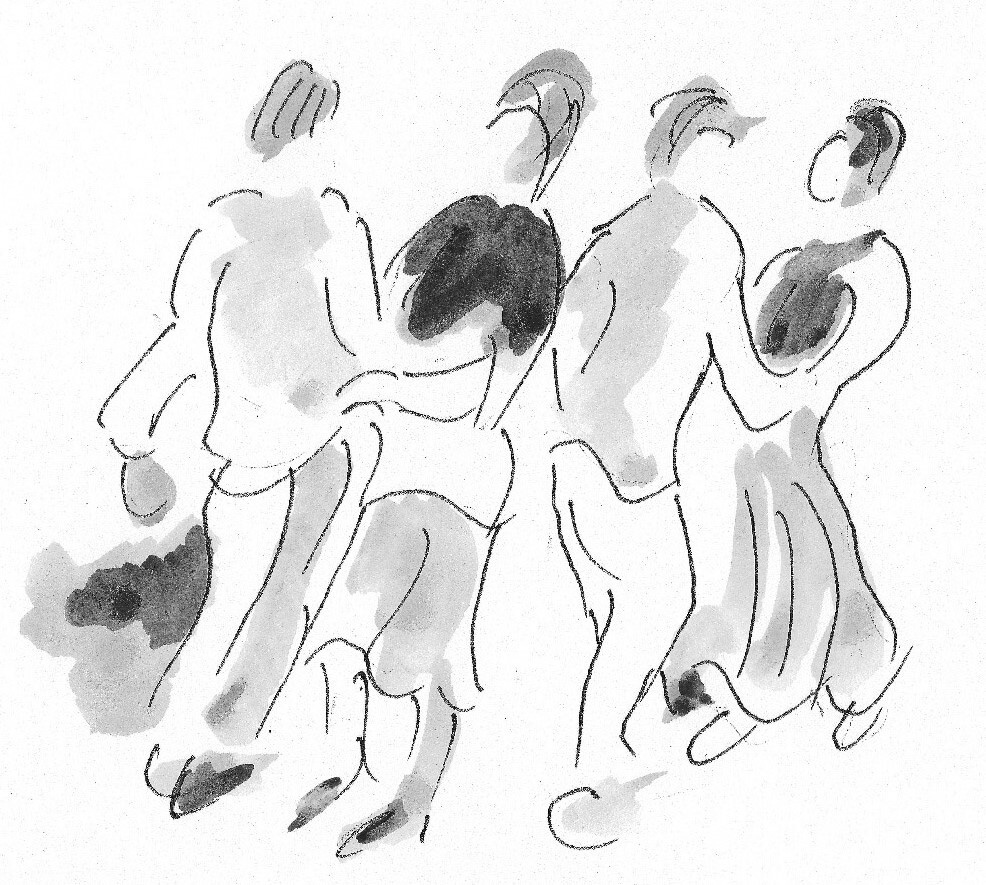
Banwood Folk Dance Club Not many dance clubs can claim to have begun life in a field, but that is just what Banwood did.

In 1928 a group of friends, led by Spencer Ranger, began learning traditional folk dances in a meadow in Woodmansterne Lane, dancing to a "wind-up" gramophone. Spencer Ranger was a friend of Cecil Sharp who led the revival of traditional music and dancing in the 1920s.

As well as the green roots of the club, Banwood also has an unusual name, formed from two distinct groups: Banstead Country Dance Club and Woodmansterne Folk Dance Club. Banstead Country Dance Club is the older branch, started even before the English Folk Dance and Song Society was set up. Woodmansterne Folk Dance Club was set up about 1960 after the success of a series of six folk dance lessons organised by St Peter's Parish Fellowship. A Mrs Gilford called the dances while her husband played the tunes on his accordion.

In the late 1970s both clubs were suffering from low membership and decided to join forces in 1979, becoming Banwood Folk Dance Club. Banwood then moved to St Ann's Church hall on the A217. They started dancing in a wooden shack until the church rebuilt the modern hall they use today.

It is now renowned as the oldest and friendliest club in the South East of England. In 2028 Banwood will celebrate its 100th anniversary. Today, with a variety of guest callers and dance styles, and a mix of live and recorded music, the emphasis is still on enjoying folk dancing.

Beginners as well as experienced dancers are always welcome to the Wednesday meetings at 8pm. Anyone interested in more information and the current programme of dance evening dates can find it by searching online for Banstead Folk Dance Club.

Bronze Age burial
Colin and Jean Sutherland, Ridge House, Park Road, Banstead, Surrey
Site where ancient human remains were found at Ridge House, Park Road, Banstead, Surrey.

We purchased Ridge House in 1984. The property had been a part of the 1913 development by Sir Henry Lambert of a new house, which he called Larklands, landscaped grounds and other buildings. Sir Henry's house is now called New Place. Our property comprises a house, which was formally for Sir Henry's staff and about an acre of land, which was part of the grounds, he laid out. We were aware, early on, that ancient remains had been found within our property because the Ordnance Survey map attached to the deeds is annotated to that effect. It was only in 2002, however, that we decided to investigate the matter more closely and came to the conclusion that the event and its location should be properly commemorated.

The correspondence between Sir Henry Lambert and the Royal College of Surgeons in 1913 is worthy of study. Briefly, however, when Larklands and its grounds were being laid out in 1913, Sir Henry had a tennis court formed in the side of the sloping ground that leads down to Park Down and then to Holly Lane. To level the ground for the court the workmen dug into the slope and it was during this work that the human remains were found. Firstly they came across an incomplete skeleton in a prepared grave, which incorporated a bed of flints. Shortly after they discovered a complete skeleton, also laid in a prepared grave but without the flint bed. Sir Henry took the bones up to London to the Royal College of Surgeons, who were the body responsible for such matters in those days. Professor Sir Arthur Keith at the College identified the first find as being the remains of a young woman and the second find as being the remains of a man of about 28 years old with well-formed lower limbs and delicate hands. Both were dated as belonging to the Bronze Age, which could put them any time between about 2700 BC and 700 BC.

The message on the plaque.
From Sir Henry Lambert's correspondence we were able to locate the general area of the burials. This is not the same place as is shown on the Ordnance Survey map. The remains were found where the sloping field was being dug out and was at a point where the original surface was more than 2 foot (600 mm) above the burials. From these clues its general position on a north south line across the eastern end of the tennis court can be deduced. Further, it was close to the area where Sir Henry planted trees above the tennis court. This places the graves at the northern end of the court, close to a dry stone wall built by Sir Henry at the time.
Mrs Sarah Goad JP, Lord Lieutenant of Surrey,unveiling the 
commemorative plaque on the 29th June 2003 After the Second World War the Royal College of Surgeons passed responsibility for ancient remains to the Natural History Museum. Despite extensive searches the Museum is, unfortunately, unable to trace the complete skeleton. It is thought that the incomplete skeleton has been destroyed but it is inconceivable that the complete one would have been as not all that many in such condition have been found. It is interesting to note that Sir Henry's last letter of 1st July 1914, brings to the attention of the Royal College the fact that they had wrongly described the skeleton in their catalogue. Perhaps it all went awry then.
Our erection of a plaque to commemorate the finding of the skeletons is intended to mark this important Banstead event. The unveiling of the plaque by Mrs Sarah Goad JP, Lord Lieutenant of Surrey, on 29th June 2003 is most appropriate because she is the great niece of Sir Henry Lambert.

Banstead Cricket Club
The earliest record of the Cricket Club is that of a home match against Twickenham in 1842. Tents and sheds were used for fifty years until a Pavilion was built.

In 1898, the ladies attending the club donated a marquee and 25 chairs and it was not until 1919 that they were allowed into the Pavilion - and then only to make tea and wash up!

Tom Gilbert, landlord of The Victoria Public House was related to W.G.(Gilbert) Grace, the famous cricketer and he was instrumental in getting Grace to play at Banstead.
Banstead Cricket Ground.  Postcard from Lewis Wood collection.

Horse Trough
The water pump and horse trough are located outside number 19 Garratts Lane.

Around the year 2000/1 a vehicle collided with the original pump which was subsequently replaced, as the damage to the original pump could not be repaired and an identical head could not be obtained.

A copy of the postcard on the right was sent to the council to show them the correct positioning of the pump in relation to the trough, however the information never got to the workmen, who installed the pump at the left hand end of the trough instead of the middle. Furthermore, in order to ensure that the pump was not stolen, a substantial amount of concrete was used, so it remains in the wrong position today.

At one time, builders working on the other side of the wall found the pipework leading to the well in Little Garratts. The house, the wall and the trough are Grade II listed.

Hourse Trough and Pump Garratts Lane Banstead. Postcard from Lewis Wood collection.
The exact history of the trough is not known although in the mid to late 19th century, hundreds of troughs were erected by the Metropolitan Drinking Fountain and Cattle Trough Association. These were usually made of granite, however, the Garratt's Lane trough is made of iron...BHRG research continues.

New Village signs
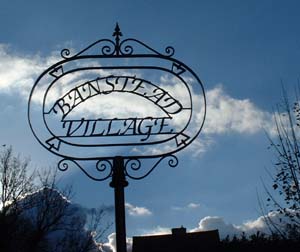
Banstead has two brand new signs at the entrance to the village courtesy of the Banstead Village Residents Association.

The signs have been erected to mark the Golden Jubilee of Queen Elizabeth II and were made by Steven Scobell and his staff at the Oyster Hill Forge in Headley.
Banstead Village Sign

Nork Park Estate Sign
Ralph Maciejewski of BHRG writes - I suspect that this sign must have been placed near to the entrance of the Nork Park Estate whose entrance gates were almost directly opposite the junction of Garratts Lane and the Brighton Road. The estate was not sold until 1924/5 by which time there were frequent bus services to and from Burgh Heath which also went to Banstead. The clue as to the location of the sign is that it states that it is 15 miles to London. This places its location as being closer to the Nork Park Estate gates rather than Banstead Railway station. Nork Park estate sign in pretty  bad condition
Public contribution to BHRG Terry Chapman writes - Ralph's idea would seem to tally with mine that this was a sign that would have been positioned near an entrance to the estate on the Brighton Road. I suppose it could also have been a sort of mock up railway sign for placement near Banstead station to advertise plots/houses on the new estate and their close proximity to the capital thus trying to appeal to commuters?!

All conjecture I know and unless someone actually remembers seeing this sign in situ then I suppose our opinions will remain as such. You can mail any information to the Webmaster.

As for the sign, I did a deal with the owner and and am happy to say I am now the new keeper! It's in a bit of a state! These enamel signs are restorable but I doubt if I'd ever find time to undertake the necessary repairs.
Well Terry, if you ever do get around to restoring it, it might look something like this!
Webmaster
Nork Park Estate sign restored using Photoshop software!


A Poem by Peter Wells (author of Banstead Urchins)

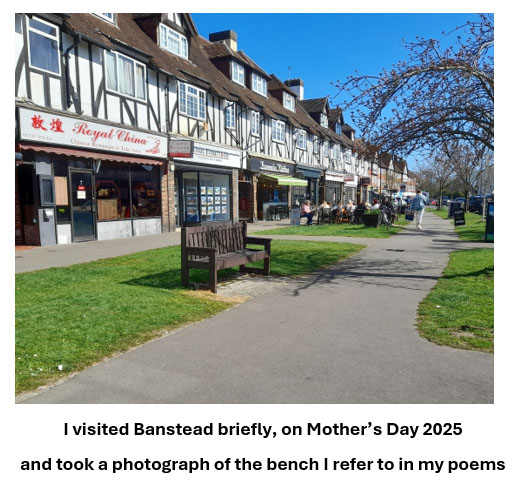
Imagine yourself sitting on a bench opposite Waitrose in the High Street and enjoy Peter's reminincinces of times gone by.

Oaktimber Banstead Peter Wells


My Banstead 

        
I lower myself on the wooden bench with the aid of my trusted stick
Resting my bones, to the annoying sound of my hip’s perpetual click
I look at the lights ever changing, enabling people to cross the road
Long ago we relied on instruction from the Highway Code
The crossing is used by adults, small girls and boys
My mind wonders to that of their toys
From Spinning tops, marbles and jacks we had owned
Now computers, gadgets and phones

 I look across the road, to my old school
And hear the children singing in the hall
Ink, nib and pen I carefully and slowly took
To enter my best handwriting into my new exercise book
My brain slowly wanders back and reminds me
It’s not nineteen hundred and fifty-three
It’s no longer a school
You silly old fool
From long ago my school’s no more
Now replaced by a massive store

As I look to my left towards the Police station, Carters and the Woolpack
Memories of many decades come flooding back
The old Well where people gathered becoming the village hub of life,
To raise the water, gossip and chatter reflecting their hardship and strife
Now a symbol of bygone days
The Well stands proudly on permanent display
Shown on book fronts, post cards and all
The image of our Well will never stall

The War Memorial I visit next
And add it to my rhyming text
Gently reminding us of those who died
Names of our dead etched on each stone side
They were sent across the seas where they bravely fought
Now they remain in sadness, memory and thought
The War Memorial stands there permanently for ever
Once a year we meet to unite and pray together

Behind me now tables and chairs placed for people sitting outside
Once surrounded by posts and chain protecting grass which we abide       
The sweet shop, shoe shop and grocers no more
Replaced with restaurants, cafes, takeaways galore                                         
 
I raise my head and look to the right
And now it shows a different sight
The huge tree on the footpath, outside Boots
Removed by officialdom and men in suits

My gaze turns towards the Church reflecting on the people there
Weddings, Funerals, Christenings, Christmas and Easters they share        
So on towards the Church and graveyard I ponder
And how many of my friends and family travelled yonder
With sadness and respect, we whisper, one last goodbye to our dead
Laid in the peacefulness of the churchyard of our beloved Banstead

Further up the high street the Co-op, Woolworth, Post Office lost in time
Replaced by shops and offices of a different kind
The Dairy, Garage and others not fitting
Unable to sustain our modern living

The Church clock chimes, it’s time for me to make a move
I rise to walk along the path with pleasant thoughts and in good mood
I hope one day to return, sit on the bench and reminisce of days gone by
If my bones flesh and mind allow I will certainly give it a very good try


My Banstead       (Second Poem)

In this poem I refer to the trees within the footpath to the west side of ‘Avenue Road’. It seems these trees have been there for an eternity and have witnessed many changes in fact ‘Banstead History image 493’ shows the well-established trees as they were in 1911. So, surviving two world wars and a horrendous fire to the Waitrose Supermarket they remain steadfastly strong to this day.

It’s another year
Since I was last here
I lower myself on my favourite seat
relieving the weight from my uneasy feet
Leaning forward with arched back
Now with many physical attributes I lack
With a body a little more thin
My stick is resting under my chin

In this pose my mind begins to recall
The old junior school steps between the long brick wall
The tall trees along Avenue Road still stand
Enduring many years and looking grand
Now looking regal in a perfect line
Planted long ago before my time

Every weekday I would get up and put on my school uniform
In Winter you needed a big coat to keep you warm
Summer brought us long days and late nights
And having to go to bed whilst it was still daylight!
Us boys would have clean shoes, short trousers, jumper and shirt
The girls would wear sandals, cardigan and a skirt

Walking to school through the park each day
Left no time for football, swing rides and play
Past the bowling green and pavilion to our right
Now the school is within our sight
We mustn’t be late and so we start to run
None of us want to be accused of being the last one

We crossed the road and through the infant school gates
Then cross legged we sat in the hall listening to Miss Bates
We had two hymns, a short talk and a prayer for assembly
And once dismissed we entered our classrooms peaceably
Three play times a day were pleasant breaks
Away from lessons and all my mistakes
I try to think of the names of other children
But alas my mind and memory are frozen
I look down to my feet for inspiration
My brain tells me it’s in need of restoration
However, names come floating back to me
John, David, and others including Rosemary
I felt a sense of achievement to having recall
Remembering some children’s names, but not them all

After school we walk home through the park together
Ignoring rain, wind, snow and all kinds of weather
Now we have time to play and climb the trees
Others catch butterflies, avoiding the angry bees
With mud on my shoes, small bits of twigs in my hair
As long as we are home for teatime no one would care
Bath nights were Sunday and Thursday to keep us clean
Where we all observed our sacred routine
Clean clothes by mother laid out on our bed
Lovingly looked after us who kept us all well fed

My mind is jogged into the present day
With all those caught up in the general fray
Remembering I could once cross the road without risk or fear
Now vehicles pass at speed, the road being rarely clear
litter on paths and streets were seldom seen
With a dedicated road sweeper keeping everything clean
The ornamental chain used to protect the grass behind me
Taken down, I assume for café owners prosperity

I hear the church clock chime again
And lift myself with a little pain
It’s time for me to leave my much-loved High Street
And make my way until next we meet
Like the swifts and the swallows who leave in the autumn
I shall go away and hibernate in my own little sanctum
Patiently waiting in my distant retreat
That I might be able to revisit and sit on my favourite seat

With all around undergoing change
I hope Banstead and its past will always remain


My Banstead      (Third Poem)

I feel that there are not so many times left
When I can visit before my memory becomes bereft
The bench seat I sit on has withstood many seasons
Witnessing people walking by, for each of their own reasons
I ease my body down to release the weight from my legs
Propping myself up using my stick ignoring the pleas my body begs

The footpath and roadway in front of me
I ponder, if it was a person or soul, would they have their own memory
I close my eyes and go to sleep
With memories of Banstead, I am able to keep

With a cynical mind I slowly envisage
The changes that might alter the face of our village
The high street finally pedestrianised
Our village transformed and begins to die
The park, bowling, tennis and cricket clubs have had their day
Sold to unseen persons without our say
They argue desperately, to persuade us the facilities had to go
For what we need is a massive carpark and giant Tesco
So, the crossing in front of me that I have observed for many a year
Is demolished like my school and for my generation brings a little tear

A small gentle hand touches my arm
The little girl is concerned and means no harm
She watches me wake from my thoughts and observed my stare
Without words she looks at me with great big eyes and full of care
I say to her I was only dreaming about the past
And how I was so sad it might not last

She asked me to tell her how it used to be when I was a small
Pointing across the road, I said when I was her age, that was my school
After a while
She started to smile
With intrigue she wanted to sit and hear so much more from me
And so, I described my teachers and classrooms from my vivid memory

She asked if I knew where she could see an old school photo
I suggested she asked her mum to take her to the library, next time they go
The church bell chimed, and she looked at me
Nodding towards her, I said, ‘It’s time to go home and get your tea.’
I wonder if she told her parents of our conversation before she went to bed If so maybe her interest in our village is secured, for our beloved Banstead

Once she was out of sight
I struggled to get up using all my might
Unsure there will be a next time I take one last look
It’s a vision I take and add to my imaginary book
I know full well my final return
Could be dust within a small urn
Ashes spread in the Garden of Remembrance near my parents is all I ask
Hopefully those who remain will carry out my wish with one last task


Peter Wells – May 2025


Public contribution to BHRG Submitted by Peter Wells and added here in Nov 2024 and May 2025.

To purchase Peter's hilarious book BANSTEAD URCHINS – A Collection of Humorous Tales, about a group of young boys getting up to all sorts of mischief in Banstead in the 1950s, visit our sales site.

Banstead Urchins by Peter Wells

Poultry farming in Banstead
Noel Phillips recollects his boyhood, growing up on a poultry farm in Croydon Lane.

"In the 1930s, I had various tasks to do every morning before going to school. Outside the five sheds, there were galvanized troughs of water. My job was to take off the covers of these drinking troughs, and in cold weather the ice had to be broken. The little trap-door in each shed had to be opened to let the hens out.
The two breeds kept were Rhode Island Reds and White Leghorns; I remember that the R.I.Rs were lovely, very quiet, good layers and a large bird for eating, and the W.Ls were easily panicked which put them off laying, they were a smaller bird for the table.
Dogs were an ever present menace to the hens; they came through from Fairlawn Grove and could wipe out a whole pen of hens in no time. Whoever spotted them first would shout 'Dogs! Dogs!' and run out to the pen, hoping someone else had heard and would follow up close behind.
Another threat to the hens were the badgers which occasionally got into the hen-houses at night and killed the birds. There were also foxes in the area, but they did not seem to touch the hens."
Poultry farm
Bill,our assistant,with the Rhode Island Reds and White Leghorns.

Noel's full account and more about life in Croydon Lane, can be found at www.norkbooks.com .....NB Click on the 'SIDELINES' tab.

Public contribution to BHRG This information was sent in by Wendy Henningsson.

Transport in Banstead
As early as 1845, a horse drawn coach left the Woolpack Inn for London every weekday morning, returning in the evening. By 1855, it only ran as far as Sutton to the railway station.
Banstead began to enjoy better services when the motor bus eventually replaced the horse drawn variety around 1913.
Within a few years of the Great War, Banstead had gained its own bus route, the 113. By 1924 there were six routes going to and from Banstead.
There is much more on this topic in the BHRG publication, The History of Banstead
Bus 113 in Cheam. Postcard from Lewis Wood collection.

Royal train
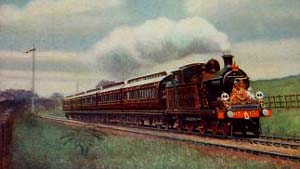
This photograph, hand-coloured for the production as a postcard, shows a London Brighton & South Coast Railway (LBSCR) "I class" 4-4-2T (T is for tank) locomotive, introduced in 1907/08 and a standard LBSCR choice for the Royal train to Epsom Downs until 1924. Royal train near Banstead
The caption on the postcard reads "Royal train near Banstead"; the towering signal on the left is one of the "intermediate signal boxes" (in use only on racing days), which means the train is either crossing the Downs between Belmont and Banstead or approaching Epsom Downs only a few hundred yards after passing through Banstead station. Which of the two locations is hard to tell.
There is more information on Banstead railway station (historic and contemporary) at http://www.wymann.info/EpsomDowns

Public contribution to BHRG This information was sent in by Adrian Wymann from Switzerland.

Scouting in Banstead (1950)
To whet the appetite of your Scouting enthusiast (Colin Sutherland member of BHRG), I attach two images. One is 3rd Banstead Cubs assembled prior to going off to summer camp in Sussex, taken on the left hand side of the goods entrance at Banstead Station, circa Aug 1949 (I am second from the left, peeping through!). Even at that age we were all in love with the Scout Mistress in the foreground!!

The second photo shows me, now a Scout, on the doorstep of 88, Wilmot Way, going off to the summer camp the following year - 1950!!( I think!!)

Brian Nibbs

Scouts 3rd Banstead 1949 outside station Scouts 3rd Banstead Brian Nibbs 1950

Banstead Scouting in the 1950s
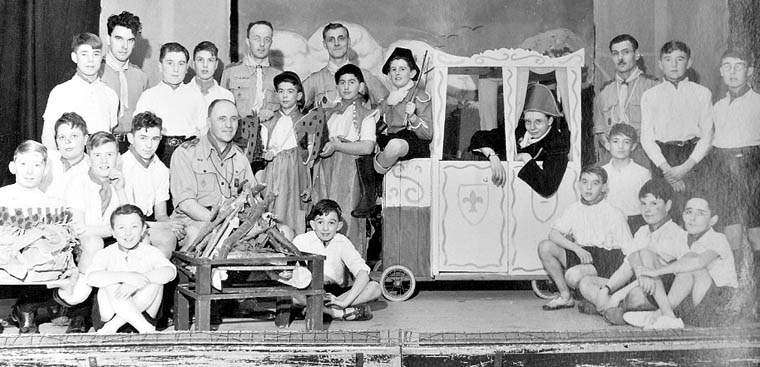
In the 1950s I belonged to the 3rd Banstead Boy Scouts, which we called the “brussel sprouts”, starting off as a cub and progressing to senior scout. We had a wonderful Scoutmaster, a very jovial chap who took several lead roles in all the annual Gang Shows we put on at the Church Institute in the High Street to support our cause. The shows emulated Ralph Reader's long-running show of the same name, with its theme tune “We're riding along on the crest of a wave!” Often, we featured skits from Gilbert and Sullivan operettas.

Scout Gang show Banstead

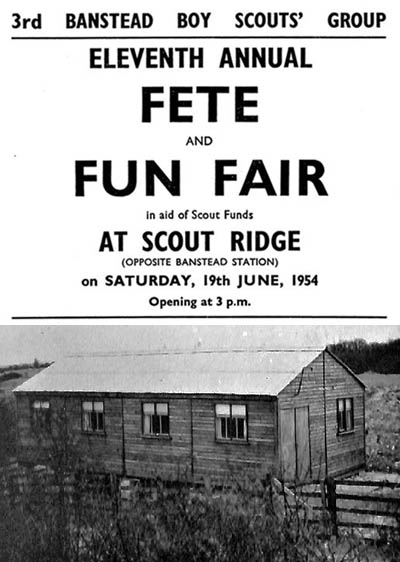
Our Hut, Scout Ridge, was beside the footpath opposite Banstead Station. Between us and the deep railway cutting was a rifle range, of all things. Every summer we loaded a massive trek cart with all our tents and gear, and we pushed and pulled it to camp beside a farm in Banstead Woods. That was no mean feat as we had to toil up, and later down, Bolters Lane… a very long and steep hill. We did so with rope and harness
while singing:Scout Ridge Banstead 1954 Fete

The 3rd Banstead Scouts are marching,
Heart high we  trudge along,
With our trek cark trundling forward,
And with a lusty yell, we’ll sing another song!

So hitch your packs boys,
Let’s be turning,
To the road, adventure waits,
The open air is calling,
And the miles will roll along!
Tiddly pom!

Sun or moon or rain in our face
We don’t care, we’ll camp at some place,
Wood and water, we’ll work with a will
Campfire burning , we’ll eat our fill,
With the stew, wonderful stew,
You’d be surprised at the things we can do!

So hitch your packs boys
Let’s be turning,
To the road, adventure waits
The open air is calling,
And the miles will roll along!
Tiddly pom, tiddly pom!

I suspect our Scoutmaster wrote this to a wartime troop marching tune. At least it kept us in unison and eased the pain, though I never understood “tiddly pom” as we couldn’t stop for a pee break!

The last time I trekked, I didn’t make the return journey. I had been expelled from the troop at camp for selling and smoking cigs I made from dry grass and the hollow stems of elderberry bushes – looking back, I should have got badges for resourcefulness and enterprise! If I had thought about it, I should have snuck out in the evening and taken incriminating photos of the scoutmasters puffing pipes and cigs behind the camp HQ; then blackmailed my way back into the troop!

A couple of good things about the scouts is that I learned to sew on buttons and use scarves as emergency arm slings. Though I suspect that if another war had come, we senior scouts would have been among the first to be conscripted. Ah, those were the days!

Bryan Cook, Ottawa, Canada, September 2021

Water supply
This photograph taken in 1906 shows a handpump over a well in the front garden of Ivy House.

Piped water came to Banstead High Street in about 1878 but many people still preferred to use water out of their wells rather than pay for the new supply.

The full photograph is included in the item for the High Street.


Pump and Well at Ivy House Banstead.  Postcard from Lewis Wood collection.

VE-Day Celebrations
This photograph, was sent in by Wendy Henningsson and appears in Wendy 's book, Home Hills & Beyond. It shows the neighbourhood Victory party for the children living in Croydon Lane.

Many of these children attended Woodmansterne school as the boundary was half way down the lane.

The party was organised by parents and neighbours.

VE- Day celebrations in Croydon Lane Banstead courtesy of Wendy HenningssonEnlarge photo

Christmas Postcard
This postcard was posted on the 24th of December 1910.

The message reads:
dear Pru,
received the card, thanking you for same.
Hoping you will have a happy Xmas.
love from Aunty.
Banstead Christmas postcard from Lewis Wood collection.